









About $6.3 billion in crypto was stolen from Binance hot wallets on Oct. 29, 2026, the largest crypto theft on record, and the FBI has attributed the attack to North Korea’s TraderTraitor group, a unit of the Lazarus Group. Before the freezes caught up, one attacker wallet deposited about 60 million USDT into Aave, borrowed 19,762 WETH against it and moved the ETH out before Tether froze the attacker’s USDT. Most of the stolen stablecoins never got that far: about $2.7–3 billion in assets in total was frozen on-chain.
The response included one of the largest coordinated stablecoin freezes on record. Tether (USDT) and Circle (USDC) froze more than $2.3 billion in stolen stablecoins combined, with the first freezes landing within about an hour of the first outflows.
On paper, that neutralized a large share of the stolen money.
But the attacker still converted part of the haul into assets that issuers cannot freeze, which exposes a basic limit: a freeze only works on tokens that are still sitting where the issuer can block them.
This was less a failure of technology than an exploitation of the gap between centralized control and decentralized protocols. The attacker turned part of the freezable stablecoins into ETH, mainly through swaps on Uniswap and UniswapX and one loan on Aave. The bulk of the stolen ETH, about 195,000 ETH, came straight from Binance’s own wallets.
Below, we break down how the attacker worked around the freeze, what role Aave played, and how a mixer such as Tornado Cash works, along with what is and is not documented about its use in this case.
The Core Problem: The Myth of Uncensorable Stablecoins
Most users believe that because USDT and USDC run on blockchains like Ethereum, they are decentralized. This is false. They are centralized corporations that issue tokens on top of decentralized networks.
These centralized issuers include a “kill switch” in their smart contracts: a blacklist function. Once an address is added, those specific tokens cannot be moved, transferred, or spent. They are dead on the chain.
Once the exploit was discovered, a clock started ticking. Any stablecoins the attacker wanted to keep had to be swapped or moved before the issuers blacklisted the addresses holding them.
Part 1: The Aave Deposit and Loan
One of the attacker’s stops was Aave, a decentralized lending protocol. Unlike Tether or Circle, Aave cannot blacklist a token or seize a user’s funds, and its smart contracts process any valid deposit and borrow. It is not without controls, though: Aave’s guardian multisigs can freeze markets, and they did so during this incident.
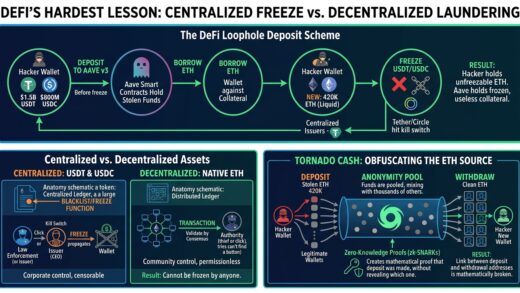
The image below provides a visual breakdown of the scheme, comparing centralized and decentralized assets.
Visual Guide to the Hack
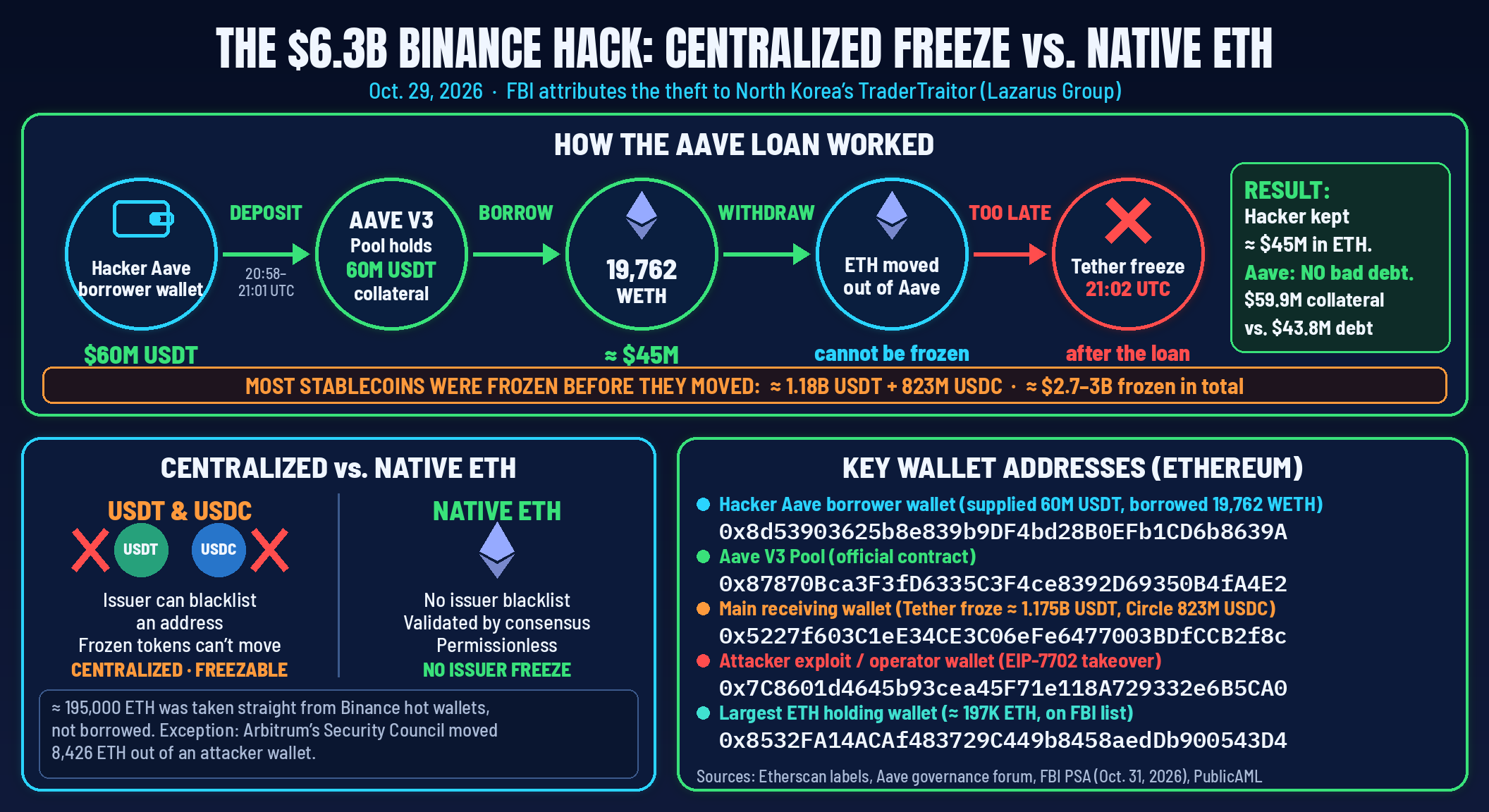
What actually happened on Aave:
-
The deposit: Between 20:58 and 21:01 UTC on Oct. 29, one wallet in the attacker’s cluster supplied about 60 million USDT to Aave V3 on Ethereum. Aave accepted the collateral because, at that moment, it was an ordinary, transferable token. This was a small slice of the stolen stablecoins: about 1.175 billion USDT was frozen in the first wallet it landed in, and about 823 million USDC was frozen as well, before either could be moved.
-
The borrow: Against that collateral, the attacker borrowed 19,762 WETH (wrapped ether), worth about $44.6 million at the time, which can be unwrapped into native ETH and moved freely. It was the attacker’s only position on Aave across all networks.
-
The result: Tether later blacklisted the attacker’s wallet, but the deposited USDT sits in Aave’s aUSDT reserve, outside that blacklist, and the borrowed ETH had already left. Aave was not left with bad debt: the position holds about $59.9 million of USDT collateral against about $43.8 million of debt, so it is over-collateralized and subject to normal liquidation. Aave’s risk steward, LlamaRisk, said it does not put Aave suppliers at risk.
-
Aave’s response: About 40 minutes after the loan, starting at 21:42 UTC, Aave’s guardian multisigs froze 175 reserves on Aave V3 across 16 networks and 117 on Aave V4, blocking new supply and borrowing while repayments, withdrawals and liquidations continued. Markets have since reopened in stages, with USDT, USDC and seven other assets held by the attacker barred from backing new borrows.
The key difference is shown in the bottom-left panel of the infographic: centralized assets (USDT/USDC) have a built-in “blacklist function” (the red ‘X’). Native ETH has no issuer blacklist; it is permissionless and validated by consensus, not by a corporation. There are exceptions at the edges: on Arbitrum, the network’s Security Council moved 8,426 ETH and 74.6 million ARB out of an attacker wallet.
Key Wallet Addresses
These Ethereum addresses are confirmed by Etherscan labels and the sources linked under each one. Each address links to its Etherscan page.
- Hacker’s Aave borrower wallet (supplied ~60M USDT, borrowed 19,762 WETH; Etherscan label “Binance Hot Wallet Exploiter 3”)
0x8d53903625b8e839b9DF4bd28B0EFb1CD6b8639A
Source: Etherscan, Aave governance forum, PublicAML - Aave V3 Pool, Ethereum (official Aave contract; Etherscan label “Aave: Pool V3”)
0x87870Bca3F3fD6335C3F4ce8392D69350B4fA4E2
Source: Etherscan, Aave address book - Main receiving wallet, where Tether froze ~1.175B USDT and Circle froze 823M USDC (Etherscan label “Binance Hot Wallet Exploiter 2”)
0x5227f603C1eE34CE3C06eFe6477003BDfCCB2f8c
Source: Etherscan, PublicAML, Elliptic - Attacker exploit/operator wallet behind the EIP-7702 takeover (Etherscan label “Binance Hot Wallet Exploiter”)
0x7C8601d4645b93cea45F71e118A729332e6B5CA0
Source: Etherscan, PublicAML - Largest attacker ETH holding wallet, ~197K ETH (on the FBI’s address list; Etherscan label “Binance Hot Wallet Exploiter 8”)
0x8532FA14ACAf483729C449b8458aedDb900543D4
Source: Etherscan, FBI list (reproduced by Hackread), PublicAML
Part 2: Mixers and Laundering (How Tornado Cash Works)
The attacker now controls hundreds of thousands of ETH (one on-chain trace counts about 430,737 ETH sitting on four attacker wallets), most of it taken directly from Binance’s hot wallets rather than borrowed. But anyone can follow that ETH on a public block explorer such as Etherscan. To spend it without being traced, an attacker has to break the link between the stolen funds and their identity.
A common tool for that is a mixer such as Tornado Cash. In this case, its documented role so far is narrower: the attacker’s starting (operational) wallet was funded with three 0.1 ETH withdrawals from Tornado Cash before the attack, according to Chainalysis, TRM Labs and Elliptic. Tracing published so far does not show the stolen ETH itself going through Tornado Cash; the FBI says the funds have been converted mainly into ETH and expects further laundering through DeFi and swap services.
The bottom-right panel of the infographic shows how a mixer like Tornado Cash breaks the chain of custody in general. Step by step:
The Obfuscation Process: Breaking the Link
-
THE DEPOSIT: A user sends ETH (in a laundering case, the “dirty” funds) into the Tornado Cash smart contract. The ETH goes in fixed denominations (e.g., 0.1 ETH, 1 ETH, 10 ETH, 100 ETH). When they make this deposit, they generate a private, mathematical note (called a ‘commitment’).
-
THE POOL (VORTEX): The deposited ETH is not held in a single wallet. It is immediately pooled with thousands of other deposits from both legitimate users and other bad actors. From the outside, the “Anonymity Pool” is just a huge mass of swirling ETH where no individual coin is identifiable.
-
THE PROOF (zk-SNARKs): To withdraw the money later, the user does not provide their original deposit information. Instead, they use zero-knowledge cryptography (specifically, zk-SNARKs).
-
How it works: This allows the user to produce a mathematical proof that proves two things:
-
I possess a legitimate note corresponding to a prior deposit in the pool.
-
This note has never been spent before.
-
-
Crucially: The proof reveals nothing else. It doesn’t reveal which specific deposit they made, when they made it, or which wallet made it.
-
-
THE WITHDRAWAL: The Tornado Cash smart contract verifies the zk-SNARK proof and releases the corresponding amount of ETH to a brand-new, completely clean withdrawal address provided by the user.
Because the zk-SNARK proof mathematically breaks the link between the entry deposit and the exit withdrawal, on-chain analysts are left with a dead end. They can see funds went into the pool, and they can see funds come out, but they cannot prove they are the same funds. The link is broken.
Final Verdict
The attacker did not need to exploit a bug in Aave. The loan used the protocol as designed: DeFi is permissionless, and a lending market will process a valid deposit and borrow until someone with the authority to freeze it acts.
The Aave piece of this hack was not a failure of code. It highlights a structural tension: as long as freezable, centrally issued stablecoins are major collateral in decentralized lending markets, there is a window between a theft and a freeze in which they can be turned into assets issuers cannot block. Aave community members have since proposed borrowing rate limits and deposit cooldowns to narrow that window.
In this case, that window was worth about $44.6 million in ETH, a small share of a roughly $6.3 billion theft that was mostly either frozen or stolen directly as ETH.